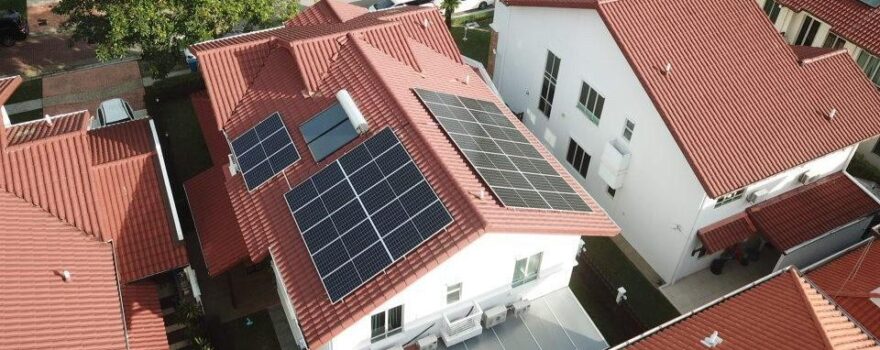
We offer solar panel installation for landed estates, Good Class Bungalows (GCBs), and commercial properties throughout the Bukit Timah neighborhood. If you have been wondering, “are you searching for solar panel installation near me or are you searching for solar panel installation near Bukit Timah,” you are in the right place. At 1st Solution Group, we combine engineering excellence with top-tier technology to help residents and businesses eliminate high electricity bills and transition to clean, renewable energy.
Generate Electricity Without the Bills: Our RTO Plans
Want to power your property with solar but prefer to avoid the initial setup costs? We offer highly flexible Rent-To-Own (RTO) plans that allow you to install a premium solar system with absolutely zero upfront investment.
With an RTO plan, you can start generating your own clean electricity immediately, effectively replacing your standard, fluctuating SP Group electricity bills. Instead of paying the utility company, you simply pay a predictable, fixed monthly rental fee for the solar system—which is typically much lower than what you were paying for grid electricity. Once your RTO tenure is complete, you take full ownership of the panels and enjoy completely free electricity for the remainder of the system’s 25+ year lifespan.
Why Bukit Timah Homeowners Choose 1st Solution
-
Compliance & Design Experts: We understand the prestigious architectural landscape of Bukit Timah and its many GCB enclaves. From the heritage-inspired bungalows to sleek, modern estates, our in-house engineering team designs optimized, compliant layouts that maximize energy yield while maintaining the high-end aesthetic of your property. We ensure your installation adheres to the specific URA guidelines that govern this prime residential district.
-
Optimized for Shaded Roofs: Got mature trees or tall neighboring buildings? We utilize advanced microinverters and DC optimizers to ensure your system performs at peak efficiency, even when parts of your roof are shaded. This is a vital consideration for Bukit Timah homes nestled within the lush, ancient greenery of the Bukit Timah Nature Reserve and the mature, tree-lined streets of Sixth Avenue.
-
Solar + EV Charging Bundles: Maximize your investment. We offer seamless integration of electric vehicle chargers with your new solar system, turning your car porch or parking area into a clean energy hub. With Bukit Timah’s prime location and easy access to the PIE and BKE, driving an EV powered by your own solar energy makes your daily travels incredibly green and cost-efficient.
-
Built for Singapore’s Weather: We utilize 5° to 10° customized tilt frames to ensure optimal self-cleaning during heavy rain, preventing debris buildup and maintaining maximum power output. This design helps quickly wash away the fine urban soot, industrial exhaust, and traffic dust common along the busy Bukit Timah Road corridor and Dunearn Road, keeping your system at peak performance.
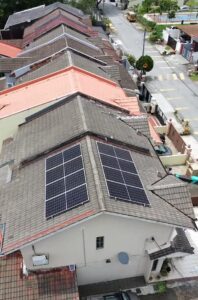
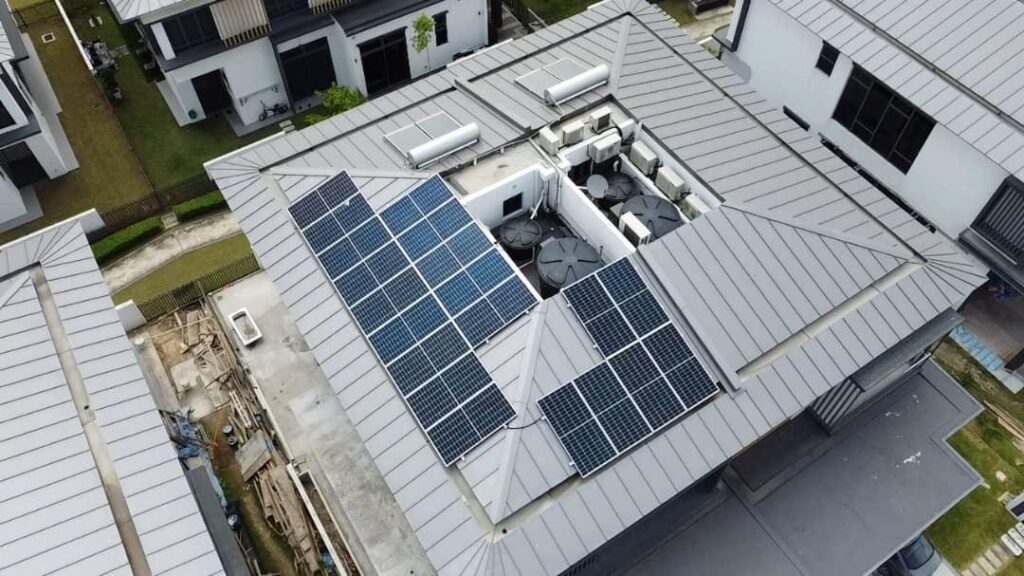
Past Clients in Bukit Timah
The 1st Solution Advantage
As a leading solar energy company and trusted EPC (Engineering, Procurement, and Construction) contractor in Singapore, we handle your entire project in-house.
-
Tier-1 Technology: We install only premium, highly efficient panels paired with the industry’s best inverters.
-
Hassle-Free Grid Integration: We manage the entire connection process with SP Group, allowing you to easily sell any excess energy back to the grid for further rebates.
-
Smart Energy Monitoring: Track your real-time solar generation and household power consumption right from your smartphone.
Ready to Cut Your Energy Bills?
Join your neighbors who have already made the switch to smart, clean energy. Reach out to our team via our Contact Us page to schedule a free roof assessment and get a customized RTO or direct purchase quote.
Frequently Asked Questions About Solar Panel Installation in Bukit Timah
1. How much can a Bukit Timah landed property save with solar panels?
A typical landed home in Bukit Timah can potentially reduce its electricity bill by around 30% to 70%, depending on its electricity consumption, available roof area, solar system size and how much electricity is used during daylight hours.
For example, a household spending around S$600 per month on electricity could potentially save approximately S$180 to S$420 per month, or about S$2,160 to S$5,040 per year, if the solar system is appropriately sized and a substantial portion of the generated electricity is consumed on-site.
Larger homes with higher electricity consumption can generate greater dollar savings. However, the percentage reduction is not determined simply by the number of panels. A proper assessment considers the property’s historical electricity consumption, roof orientation, roof pitch, shading, available installation area and daytime electricity demand.
For a more accurate estimate, we assess the property and model expected annual solar generation before recommending the system size.
2. How many solar panels does a typical Bukit Timah landed home need?
The number of panels depends on the property’s electricity consumption and available roof area.
For example, a modern high-efficiency panel may produce approximately 430W to 550W per panel. A system using 20 panels rated at 500W each would have a nominal capacity of approximately 10 kWp.
A larger landed property may require a 10 kWp to 20 kWp system or more, particularly where the household has high air-conditioning usage, multiple refrigerators, swimming-pool equipment, water heaters or electric vehicle charging.
Panel count alone is not enough to determine system capacity. Our engineers also consider roof dimensions, panel spacing, orientation, shading and electrical design.
3. How much electricity can a solar system generate in Singapore?
Singapore receives strong solar irradiation throughout the year, making photovoltaic systems suitable for both residential and commercial properties.
As a broad planning estimate, a well-designed 10 kWp system may generate around 11,000 to 14,000 kWh of electricity annually, although actual production varies according to roof orientation, shading, equipment efficiency, weather and system losses.
That works out to roughly 900 to 1,170 kWh per month on an annualised basis.
For a 15 kWp system, annual production could therefore be approximately 16,500 to 21,000 kWh, subject to the property’s actual site conditions.
These figures should be treated as engineering estimates rather than guaranteed production figures. A site-specific solar assessment provides a more reliable projection.
4. How much roof space is required for solar panels on a Bukit Timah bungalow?
Modern panels commonly require approximately 1.8 to 2.3 square metres per panel, depending on the panel dimensions.
For example, 20 panels could require roughly 36 to 46 square metres of panel surface area, before accounting for roof access, setbacks, walkways, equipment and the physical configuration of the roof.
A large GCB or bungalow may have substantially more usable roof area than a typical terrace property. However, not every section of a roof should necessarily be covered with panels.
We assess roof orientation, shading, structural considerations and safe maintenance access before determining the usable solar area.
5. Will solar panels work on a Bukit Timah property surrounded by trees?
Yes, but shading needs to be analysed carefully.
This is particularly relevant in parts of Bukit Timah where mature trees and surrounding vegetation can cast shadows across roofs. Even partial shading can reduce photovoltaic output.
For roofs with different shading conditions across individual panels, technologies such as microinverters or DC power optimizers can help reduce the impact of panel-level performance differences.
With a conventional string inverter, several panels are connected together in electrical strings. If one part of a string is significantly affected by shading, the output of that string can be reduced. Panel-level power electronics can provide greater flexibility where roof sections have different orientations or shading profiles.
The correct solution depends on the actual roof rather than simply selecting the most expensive equipment.
6. What is the difference between solar panels, inverters and microinverters?
Solar panels convert sunlight into DC electricity. Most household electrical equipment operates using AC electricity, so an inverter is required to convert the electricity into a usable form for the property.
A conventional string-inverter system connects multiple panels into strings before sending the DC electricity to a central inverter.
A microinverter is installed at or near individual panels and converts the DC output to AC at panel level.
The choice affects system design, monitoring, shading performance, maintenance and cost. For a large Bukit Timah property with multiple roof orientations, complex roof geometry or partial shading, microinverters or optimizers may provide useful design advantages.
7. Can I completely eliminate my SP Group electricity bill?
Usually, solar should not be described as automatically eliminating the electricity bill.
Solar panels generate electricity primarily during daylight hours. Your property may still draw electricity from the grid at night or whenever household consumption exceeds solar production.
For example, a home might generate 40 kWh of solar electricity during a particular day but consume 15 kWh during daylight hours and another 25 kWh at night. The solar system can substantially reduce grid consumption, but electricity may still be imported from the grid depending on the property’s consumption pattern.
Battery storage can shift some solar energy for use later, but adding batteries increases the system cost and requires a separate assessment.
8. Is it better to use solar electricity during the day or export it to the grid?
For many landed properties, using solar electricity directly within the home can be particularly valuable because it reduces the amount of electricity that needs to be purchased from the grid.
For example, solar generation can be used for air-conditioning, water heating, pumps, appliances, swimming-pool equipment and EV charging while the system is producing electricity.
If solar generation exceeds the property’s instantaneous consumption, eligible excess electricity may be exported to the grid under Singapore’s prevailing arrangements.
This means system design should consider not only how many panels can fit on the roof, but also when the household actually consumes electricity.
9. Can I charge my electric vehicle using my Bukit Timah home’s solar panels?
Yes. Solar panels can be integrated with an EV charger so that your property can use solar-generated electricity to charge an electric vehicle.
For example, if your solar system is producing excess electricity during the afternoon and your EV is connected to a suitable charger, part of that generation can potentially be directed towards vehicle charging.
An EV can also become a significant daytime electricity load. This may increase the amount of solar electricity consumed on-site rather than exported to the grid.
The appropriate charger rating depends on the vehicle, electrical supply and existing property load. A site assessment is required to determine whether additional electrical infrastructure is necessary.
10. How much does solar panel installation cost for a Bukit Timah landed property?
The cost depends heavily on system size, panel and inverter selection, roof complexity, electrical works, access requirements and whether the project is a direct purchase or financing arrangement.
As an indicative range, a residential solar installation in Singapore can commonly fall in the five-figure range for a properly sized landed-home system. A 10 kWp system, for example, is a substantially different project from a 20 kWp system, and premium equipment or complex roofs can increase the total cost.
Rather than quoting a generic price based solely on panel count, we calculate the expected system capacity, annual generation, estimated savings and payback period for the specific property.
11. How long does it take for solar panels to pay for themselves?
The payback period depends primarily on the installation cost, electricity tariff, annual solar production and the proportion of solar electricity that is consumed on-site.
For example, if a system costs S$30,000 and generates electricity worth an average of S$4,000 per year, the simple payback period would be approximately 7.5 years.
Actual payback can be shorter or longer. Higher household electricity consumption can increase the value of solar generation, while significant shading or low daytime consumption may reduce the financial benefit.
Solar panels generally have a useful operating life of 25 years or more, so a system that reaches payback within its first several years can potentially provide many additional years of electricity generation.
12. What happens to solar panels during Singapore’s heavy rain?
Solar photovoltaic systems are designed for outdoor operation and Singapore’s tropical climate.
Rain can naturally wash dust and surface debris from panels, while the panels are installed at an angle to allow water to drain away.
A typical system does not need to be manually cleaned every few days. However, properties surrounded by trees may experience greater accumulation of leaves, bird droppings or other debris and may benefit from periodic inspection and cleaning.
Our systems can use customised mounting configurations, including approximately 5°–10° tilt where appropriate, although the optimum angle depends on the actual roof and structural conditions.
13. Do solar panels still generate electricity when it is cloudy?
Yes. Solar panels do not require direct, bright sunshine to generate electricity.
They can continue producing electricity from diffuse sunlight during cloudy weather, although output will normally be lower than under strong sunlight.
For this reason, annual solar production estimates should account for Singapore’s changing weather conditions rather than assuming that every day will deliver maximum panel output.
14. Do I need a battery for a solar system in Bukit Timah?
Not necessarily.
A grid-connected solar system can operate without batteries. During the day, solar electricity can supply the property, while electricity can still be imported from the grid when solar generation is insufficient.
A battery becomes more relevant if the homeowner wants to store excess solar electricity for later use, increase solar self-consumption or provide backup power for selected loads.
However, batteries add additional capital cost, equipment and maintenance considerations. For many grid-connected homes, installing solar without a battery can be the more straightforward starting point.
15. How long do solar panels and inverters last?
Solar panels are generally designed for a service life of 25 years or more, with manufacturers typically providing long-term performance warranties.
The inverter is an electronic component and may have a shorter expected service life than the panels. Its lifespan depends on the equipment, operating environment and system design.
This is why a solar quotation should not be evaluated solely by the number of panels or the headline installation price. Homeowners should also consider the panel warranty, inverter warranty, degradation rate, monitoring system and after-sales support.
16. Is solar suitable for a Good Class Bungalow in Bukit Timah?
Yes. GCBs can be particularly suitable for solar because they often have substantial roof areas and relatively high electricity consumption.
However, GCB projects can also involve more complex architectural requirements. Roof geometry, multiple roof sections, landscaping, shading, visual considerations and electrical loads may all affect the system design.
For these properties, we recommend an engineering assessment rather than using a standard package designed for smaller homes.
17. Can I install solar panels if my Bukit Timah home has several different roof orientations?
Yes. A solar system can be designed around multiple roof orientations.
Different roof faces may receive sunlight at different times of the day. Depending on the layout, panels can be separated into different electrical strings or paired with suitable power electronics to manage different orientations and shading conditions.
This can be particularly useful for larger bungalows where the roof consists of several sections rather than one large, uniform roof plane.
18. How does 1st Solution calculate my potential solar savings?
We consider several factors rather than simply multiplying the number of panels by their rated capacity.
The assessment can include:
- Historical electricity consumption
- Monthly electricity bills
- Roof dimensions and usable roof area
- Roof orientation and pitch
- Solar irradiation
- Partial and seasonal shading
- Panel wattage and efficiency
- Inverter efficiency
- Expected system losses
- Estimated annual kWh generation
- Daytime versus nighttime electricity consumption
- Potential grid export
- Installation cost
- Expected annual savings
- Estimated payback period
This allows homeowners to compare the expected financial return of different system sizes instead of choosing a system based purely on the number of panels that can fit on the roof.
19. Can I get a solar assessment before deciding whether to install?
Yes. We can assess the property and provide a recommended system configuration based on its roof conditions and electricity consumption.
For a Bukit Timah landed property, the assessment is particularly useful because two neighbouring houses can have completely different solar potential due to differences in roof orientation, tree shading, roof area and household electricity usage.
20. Is Rent-To-Own better than buying my solar system outright?
It depends on your financial priorities.
With a direct purchase, you pay the installation cost upfront but own the system immediately. This can provide a straightforward long-term investment structure.
With a Rent-To-Own (RTO) arrangement, you can avoid the large initial capital expenditure and make fixed monthly payments during the agreed tenure. Once the RTO period is completed according to the agreement, ownership of the system transfers to you.
For example, a homeowner who would rather preserve S$30,000–S$50,000 of capital for renovation, investments or other purposes may prefer an RTO structure even if a cash purchase provides a different overall financial return.
The right option depends on the property’s electricity savings, system price, RTO tenure, monthly payment and ownership terms.
21. How much can a solar system reduce carbon emissions?
Solar electricity reduces the amount of electricity that needs to be supplied from the grid. The environmental benefit therefore depends on the amount of solar electricity generated and consumed or exported.
For example, a system generating 12,000 kWh of electricity annually would produce approximately 300,000 kWh over 25 years, before accounting for panel degradation.
The actual avoided emissions depend on Singapore’s prevailing electricity-grid emissions factor. We therefore recommend using the project’s estimated annual kWh generation when calculating its environmental contribution rather than presenting a generic carbon-saving figure.
22. Why should Bukit Timah homeowners choose an experienced solar EPC contractor?
A solar installation is more than attaching panels to a roof.
The contractor needs to assess the roof, design the DC and AC electrical system, select compatible panels and inverters, manage mounting structures, conduct electrical testing, coordinate grid connection requirements and provide ongoing monitoring and support.
For a high-value landed property or GCB in Bukit Timah, good engineering is particularly important because the system needs to balance energy generation, safety, aesthetics, roof conditions, electrical requirements and long-term reliability.
1st Solution Group provides end-to-end solar EPC services, including system design, equipment procurement, installation, grid integration and monitoring.
23. How do I find out exactly how much I can save with solar in Bukit Timah?
The most accurate approach is to assess your actual electricity consumption and property rather than relying on a generic online calculator.
Provide your recent electricity bills and allow our team to assess the roof area, orientation and shading. We can then estimate the appropriate system capacity, expected annual generation, potential electricity savings, estimated payback period and available RTO option.
For a Bukit Timah landed property, this gives you a much clearer picture of whether a 5 kWp, 10 kWp, 15 kWp, 20 kWp or larger system makes financial and technical sense.