We offer solar panel installation for landed estates, commercial spaces, and industrial properties throughout the Jurong East neighborhood. If you have been wondering, “are you searching for solar panel installation near me or are you searching for solar panel installation near Jurong East,” you are in the right place. At 1st Solution Group, we combine engineering excellence with top-tier technology to help West Coast residents and businesses eliminate high electricity bills and transition to clean, renewable energy.
Generate Electricity Without the Bills: Our RTO Plans
Want to power your property with solar but prefer to avoid the initial setup costs? We offer highly flexible Rent-To-Own (RTO) plans that allow you to install a premium solar system with absolutely zero upfront investment.
With an RTO plan, you can start generating your own clean electricity immediately, effectively replacing your standard, fluctuating SP Group electricity bills. Instead of paying the utility company, you simply pay a predictable, fixed monthly rental fee for the solar system—which is typically much lower than what you were paying for grid electricity. Once your RTO tenure is complete, you take full ownership of the panels and enjoy completely free electricity for the remainder of the system’s 25+ year lifespan.
Why Jurong East Homeowners Choose 1st Solution
-
Compliance & Design Experts: We understand the diverse architectural landscape of Jurong East and the rapidly developing Jurong Lake District. From the residential enclaves near Toh Guan and Jurong East Avenue 1 to larger commercial facilities, our in-house engineering team designs optimized, compliant layouts that maximize energy yield for your specific roof profile. Whether your property is a private home or a commercial building capitalizing on the area’s transformation into Singapore’s second CBD, we ensure your installation meets all local structural and safety guidelines.
-
Optimized for Shaded Roofs: Got mature trees or tall neighboring buildings? We utilize advanced microinverters and DC optimizers to ensure your system performs at peak efficiency, even when parts of your roof are shaded. This is especially crucial for properties shaded by the lush greenery of the nearby Jurong Lake Gardens or the towering high-rises in the bustling town center.
-
Solar + EV Charging Bundles: Maximize your investment. We offer seamless integration of electric vehicle chargers with your new solar system, turning your car porch or parking area into a clean energy hub. With Jurong East’s strategic access to the PIE and AYE, driving an EV powered by your own solar energy makes navigating the West or commuting into the city center incredibly green and cost-effective.
-
Built for Singapore’s Weather: We utilize 5° to 10° customized tilt frames to ensure optimal self-cleaning during heavy rain, preventing debris buildup and maintaining maximum power output. This design helps quickly wash away the mix of urban dust and natural leaf litter brought in by the breezes off Jurong Lake, keeping your system running at peak performance year-round.
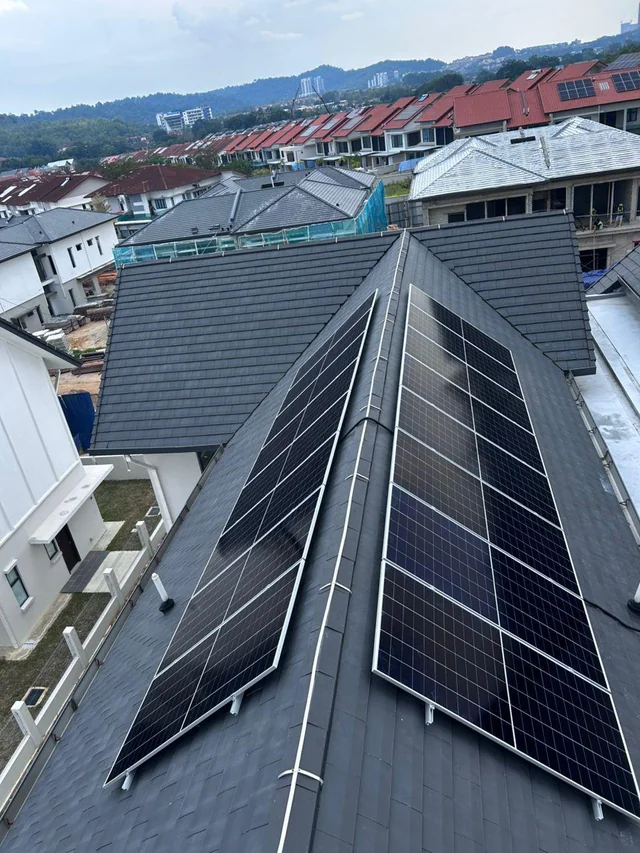
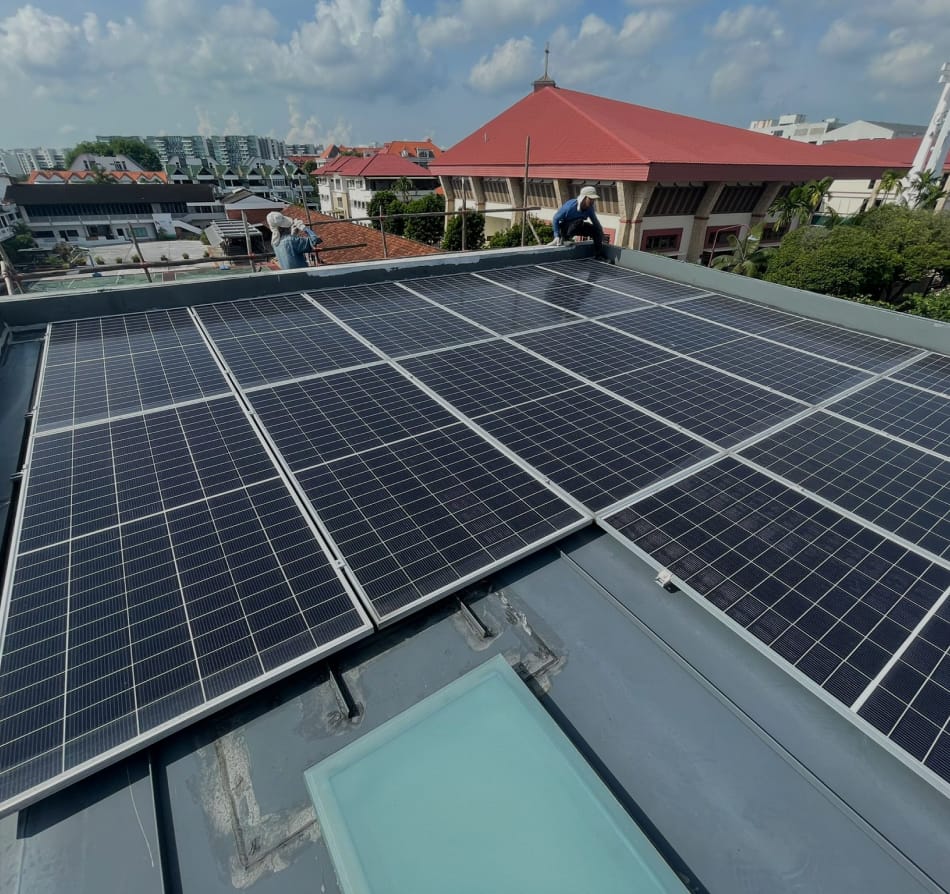
Past Customer Installations
The 1st Solution Advantage
As a leading solar energy company and trusted EPC (Engineering, Procurement, and Construction) contractor in Singapore, we handle your entire project in-house.
-
Tier-1 Technology: We install only premium, highly efficient panels paired with the industry’s best inverters.
-
Hassle-Free Grid Integration: We manage the entire connection process with SP Group, allowing you to easily sell any excess energy back to the grid for further rebates.
-
Smart Energy Monitoring: Track your real-time solar generation and household power consumption right from your smartphone.
Ready to Cut Your Energy Bills?
Join your neighbors in the West who have already made the switch to smart, clean energy. Reach out to our team via our Contact Us page to schedule a free roof assessment and get a customized RTO or direct purchase quote.
Frequently Asked Questions About Solar Panel Installation in Jurong East
1. How much can a Jurong East property save with solar panels?
A properly sized solar system can potentially reduce a property’s electricity costs by approximately 30% to 70%, although the actual percentage depends on electricity consumption, roof size, system capacity, shading and how much electricity is consumed while the panels are generating power.
For example, a landed property spending S$500 per month on electricity could potentially save around S$150 to S$350 per month, equivalent to approximately S$1,800 to S$4,200 per year.
A commercial or industrial property with a S$5,000 monthly electricity bill could potentially have much greater dollar savings. A 30% to 70% reduction would represent approximately S$1,500 to S$3,500 per month, or S$18,000 to S$42,000 per year.
These are illustrative ranges rather than guaranteed savings. The actual savings depend on the solar system’s annual kWh production and the property’s electricity consumption profile.
2. How much electricity can solar panels generate in Jurong East?
Singapore’s location near the equator provides strong year-round solar potential. A useful preliminary estimate for a well-designed system is approximately 1,100 to 1,400 kWh of electricity per year for every 1 kWp of installed solar capacity, although actual generation varies with roof orientation, shading, panel temperature, system losses, inverter efficiency and weather.
For example:
| Solar System | Approximate Annual Generation |
|---|---|
| 5 kWp | 5,500–7,000 kWh/year |
| 10 kWp | 11,000–14,000 kWh/year |
| 15 kWp | 16,500–21,000 kWh/year |
| 20 kWp | 22,000–28,000 kWh/year |
| 50 kWp | 55,000–70,000 kWh/year |
| 100 kWp | 110,000–140,000 kWh/year |
These figures are for initial planning only. A proper engineering assessment should use the property’s actual roof characteristics and expected system losses.
3. How many solar panels does a typical Jurong East property need?
The number of panels depends on the required system capacity and the wattage of the selected modules.
For example, using 500W panels:
- 10 panels = approximately 5 kWp
- 20 panels = approximately 10 kWp
- 30 panels = approximately 15 kWp
- 40 panels = approximately 20 kWp
- 100 panels = approximately 50 kWp
- 200 panels = approximately 100 kWp
A modern panel can occupy roughly 2 square metres of roof area, although the final space requirement is higher once access, mounting arrangements, roof edges, equipment and maintenance considerations are included.
A Jurong East landed home might therefore use 15–40 panels, while a large commercial or industrial rooftop can accommodate hundreds or even thousands of panels.
4. How much roof space do I need for solar panels?
As a broad estimate, a 10 kWp system using 500W panels could require approximately 40–50 square metres of practical roof area, depending on the panel dimensions and roof configuration.
A 20 kWp system could require approximately 80–100 square metres, while a 100 kWp installation could require roughly 400–500 square metres or more.
However, simply measuring the total roof area is not enough. Areas occupied by rooftop equipment, water tanks, access routes, parapets, skylights, vents and maintenance zones may not be available for panel installation.
5. Is solar suitable for Jurong East landed houses?
Yes. Landed properties can be particularly suitable because homeowners have access to their own roof area and can design the system around their household’s electricity consumption.
A larger landed home with several air-conditioning units, water heaters, multiple refrigerators, pumps, home offices or an EV charger may have substantial electricity consumption.
For example, a household consuming 1,500 kWh per month uses approximately 18,000 kWh per year. A 15 kWp system producing around 16,500–21,000 kWh annually could potentially cover a substantial proportion of that electricity demand, although actual grid savings will depend on when the household consumes electricity.
6. Can solar significantly reduce the electricity bill of a Jurong East commercial property?
Yes. Commercial properties can sometimes achieve strong financial benefits because they often consume electricity during the same daytime period when solar panels are generating electricity.
For example, a commercial building using 20,000 kWh per month during operating hours has a very different solar consumption profile from a home that uses much of its electricity at night.
A 100 kWp system could potentially generate around 110,000–140,000 kWh annually under the preliminary production range above.
If a substantial portion is consumed directly by the building, the system can reduce the amount of electricity that needs to be purchased from the grid.
For larger commercial properties, we recommend analysing at least 12 months of electricity consumption data rather than estimating savings from the monthly bill alone.
7. Is solar suitable for warehouses and industrial buildings around Jurong East?
Yes. Large industrial and warehouse rooftops can offer substantial areas for photovoltaic installations.
This is particularly relevant across Singapore’s western industrial areas. JTC reported that around 800 MWp of solar capacity had been installed across its estates by 2024, covering building rooftops, vacant industrial land and lessee properties.
Large roofs can accommodate systems from 100 kWp to several MWp, depending on the available roof area, electrical infrastructure, structural loading and project requirements.
For example, a 500 kWp system could have an indicative annual generation range of approximately 550,000–700,000 kWh.
At this scale, even a modest reduction in the property’s electricity purchase requirements can translate into substantial annual savings.
8. How much can a 100 kWp solar system save?
A 100 kWp system could preliminarily generate around 110,000–140,000 kWh per year.
If the property is able to use most of this electricity directly and the effective avoided electricity cost were, for illustration, S$0.25/kWh, the electricity value would be approximately:
110,000 kWh × S$0.25 = S$27,500 per year
to
140,000 kWh × S$0.25 = S$35,000 per year.
At an illustrative effective value of S$0.30/kWh, the same generation would represent approximately S$33,000–S$42,000 per year.
These calculations demonstrate why commercial and industrial solar projects should be assessed using actual electricity consumption and tariff information rather than a generic “percentage savings” claim.
9. What happens if my Jurong East property produces more solar electricity than it uses?
When solar generation exceeds the property’s instantaneous electricity consumption, eligible excess electricity can be exported to the grid under Singapore’s prevailing arrangements.
EMA explains that consumers with embedded solar photovoltaic generation can be compensated for eligible electricity sold back to the grid, while electricity consumed from the grid is separately measured.
However, exporting electricity is generally not equivalent to using the solar electricity directly within the property. For this reason, system design should consider self-consumption, not simply maximum possible panel capacity.
10. Is it better to consume solar electricity or export it?
In many cases, using solar electricity directly can provide greater value than exporting it.
For example, if a factory is operating during the day and solar production is being generated at the same time, the electricity can directly supply machinery, air-conditioning, lighting, refrigeration and other loads.
If the building is using 100 kWh at a particular time and the solar system is generating 80 kWh, much of that solar energy can potentially be consumed directly.
If the building is only using 20 kWh while the solar system produces 80 kWh, the remaining generation may need to be exported or otherwise managed.
This is why a commercial solar assessment should examine the property’s load profile, not just its total annual electricity consumption.
11. Can I install solar panels on a Jurong East factory or warehouse roof?
Potentially, yes, subject to the building, lease, structural, electrical and regulatory requirements.
Roof type is an important consideration. EMA notes that reinforced-concrete roofs are commonly suitable for solar mounting systems, while metal roofs can often use seam clamps where appropriate. Clay and concrete tiled roofs can also accommodate solar installations with suitable mounting methods.
The roof should be inspected before installation. Older roofs, roofs with existing defects or roofs requiring structural reinforcement may require remedial work before solar panels can be installed.
12. Do solar panels add too much weight to a commercial roof?
The additional load depends on the panel, mounting system and installation method.
A structural assessment should consider the existing roof structure, mounting arrangement, wind loads and any other rooftop equipment.
This is particularly important for older industrial buildings. Solar should not be installed simply because there appears to be sufficient empty roof space.
Our engineering process considers the roof structure and proposed mounting arrangement before finalising the system.
13. What type of inverter is suitable for a Jurong East solar installation?
The inverter converts the panels’ DC electricity into AC electricity that can be used by the building.
For smaller residential systems, a string inverter or microinverter configuration may be appropriate depending on roof conditions.
For larger commercial and industrial systems, multiple string inverters or larger commercial-grade inverter configurations may be used.
The choice depends on:
- System capacity
- Number of roof sections
- Panel orientation
- Shading
- Electrical architecture
- Monitoring requirements
- Maintenance access
- Grid connection requirements
A large industrial roof may therefore require several inverters rather than one oversized unit.
14. What if part of my Jurong East roof is shaded?
Shading can come from neighbouring buildings, rooftop structures, trees, water tanks, mechanical equipment and other obstructions.
A shaded panel generally produces less electricity. If multiple panels are connected in a string, differences in panel output can affect the string’s overall performance.
For more complex roofs, microinverters or DC optimizers can be considered to provide more granular control over panel-level performance.
A professional design should include a shading assessment rather than simply assuming that every square metre of roof will receive the same amount of sunlight.
15. Can solar panels work on a metal warehouse roof?
Yes. Metal roofs are commonly used for commercial and industrial buildings, and certain seam-profile metal roofs can be suitable for solar mounting systems using clamps rather than roof penetration.
However, the actual roof profile, condition, structural capacity, corrosion risk and mounting system compatibility must be checked.
A roof that is nearing the end of its service life may also be better repaired or replaced before installing a solar system expected to operate for 25 years or more.
16. How long does solar installation take in Jurong East?
The installation period depends heavily on system size and building type.
For a landed residential property, the physical installation may take approximately 1–2 weeks, depending on weather and project complexity. BCA’s solar FAQ similarly notes that landed-property PV installation usually takes 1–2 weeks.
Commercial and industrial projects can take several weeks or months, particularly for large systems requiring extensive mounting, electrical works, testing and coordination.
17. Do solar panels require planning approval in Jurong East?
The requirements depend on the property and installation configuration.
URA’s current guidance states that ancillary rooftop solar installations generally do not require planning permission, except in specified circumstances such as certain urban-design or conservation areas and certain elevated solar installations. For landed housing, solar panels raised more than 1 metre above roof level can fall within the elevated-panel rules.
The project should therefore be assessed against the applicable URA requirements rather than assuming that every rooftop installation is treated identically.
18. Can solar panels be installed on a Jurong East condominium?
Potentially, but condominium installations are different from landed-property installations.
The homeowner generally does not have exclusive control over the entire condominium roof. Common-property areas, MCST requirements and building management approval may therefore affect whether an individual installation is possible.
For condominium developments, solar is often more practical as a development-wide rooftop project rather than an individual apartment installation.
19. How much does solar panel installation cost in Jurong East?
There is no single price because a residential 10 kWp system and a commercial 500 kWp system are completely different engineering projects.
For example, the final price can be affected by:
- System capacity
- Number and type of panels
- Inverter configuration
- Mounting structure
- Roof type
- Structural works
- Cable routes
- Electrical switchboard modifications
- Monitoring equipment
- Access requirements
- Testing and commissioning
- Grid connection requirements
A five-figure budget can be realistic for many landed-home systems, while larger commercial and industrial systems can cost substantially more.
The more useful calculation is installation cost ÷ expected annual financial benefit, rather than comparing quotations purely on total price.
20. What is the typical solar payback period?
The payback period depends on the installed cost and the value of the electricity generated.
For example, if a solar system costs S$30,000 and produces electricity worth approximately S$4,000 annually, the simple payback period would be:
S$30,000 ÷ S$4,000 = 7.5 years
If the same system generated savings worth S$5,000 per year, the simple payback would fall to approximately 6 years.
Actual calculations should account for electricity tariffs, exported electricity, system degradation, maintenance and financing costs.
Because solar panels can have operating lives of 25 years or more, a system that achieves payback within its first several years can continue generating electricity after the initial investment has been recovered.
21. Can I use solar panels to charge EVs at my Jurong East property?
Yes. Solar and EV charging can be integrated for both residential and commercial applications.
For a landed home, an EV charger can become a useful daytime load that consumes excess solar generation.
For a commercial property, warehouse or business premises with an EV fleet, solar can potentially supply part of the charging demand during operating hours.
For example, a 10 kWp solar system producing around 11,000–14,000 kWh annually could provide a significant amount of electricity for EV charging, although the actual amount depends on vehicle charging schedules and other building loads.
The electrical supply must also be assessed to ensure that the charger and solar system can operate safely within the property’s available capacity.
22. Do I need batteries with solar panels in Jurong East?
No. A grid-connected solar system does not automatically require battery storage.
Batteries are useful when a property wants to store excess solar electricity for later use, such as after sunset, or when backup power is a priority.
However, batteries add additional capital expenditure and have their own capacity, efficiency, degradation and replacement considerations.
For a commercial property that already consumes substantial electricity during daylight hours, direct solar consumption may provide a stronger economic case without installing a large battery.
23. How long do solar panels last in Singapore?
Quality solar panels are generally designed for 25 years or more of operation.
Panel performance gradually declines over time rather than suddenly stopping after 25 years. Manufacturers commonly provide long-term performance warranties specifying minimum output after a defined period.
The inverter may have a different expected service life, so homeowners and businesses should consider inverter warranty coverage and potential future replacement when calculating the long-term economics of the system.
24. Will heavy rain affect solar generation in Jurong East?
Rain reduces solar irradiance and therefore generally reduces instantaneous generation. However, rainfall can also help wash away dust and surface debris.
Solar panels are designed for outdoor conditions, but the system still needs appropriate mounting, drainage, electrical protection and waterproofing.
Properties surrounded by trees or exposed to significant dust may require periodic inspection and cleaning to maintain performance.
25. How much can a Jurong East factory reduce its carbon emissions with solar?
The environmental benefit can be estimated directly from the amount of solar electricity generated.
For example, a 500 kWp system generating approximately 550,000–700,000 kWh per year would produce roughly 13.75–17.5 million kWh over 25 years, before allowing for performance degradation.
The corresponding avoided emissions should be calculated using the applicable Singapore electricity-grid emissions factor rather than using a generic international figure.
This provides companies with a more defensible basis for sustainability reporting and internal carbon-reduction calculations.
26. Is Rent-To-Own solar available for Jurong East properties?
Yes. For eligible properties, a Rent-To-Own (RTO) structure can provide an alternative to paying the full solar installation cost upfront.
Instead of making a large initial capital payment, the property owner pays an agreed monthly amount during the RTO tenure.
For example, a business that does not want to allocate S$50,000, S$100,000 or more of capital to a solar installation may consider an RTO structure, depending on the project’s size and eligibility.
The important figures to compare are the monthly RTO payment, expected solar savings, contract tenure, maintenance responsibilities, ownership-transfer terms and total amount payable.
27. Is solar worth installing on a Jurong East commercial or industrial property?
It can be particularly attractive when the property has:
- A large usable roof
- High daytime electricity consumption
- Long operating hours
- Minimal shading
- A roof with sufficient remaining service life
- Stable occupancy
- High electricity expenditure
- Suitable electrical infrastructure
For example, a factory spending S$20,000 per month on electricity has an annual electricity expenditure of approximately S$240,000.
If solar reduced the electricity purchase requirement by an illustrative 30%, that would represent approximately S$72,000 of annual electricity-cost reduction before accounting for exported electricity and other project-specific factors.
A 50% reduction would represent approximately S$120,000 per year.
The actual result depends on the solar system’s production and the property’s load profile, but these calculations demonstrate why large Jurong East commercial and industrial roofs can have substantial solar potential.
28. How does 1st Solution calculate my Jurong East solar savings?
We do not determine the system size simply by looking at the available roof area.
Our assessment considers:
- At least 12 months of electricity consumption where available
- Monthly electricity bills
- Building operating hours
- Daytime load profile
- Roof dimensions
- Roof orientation
- Roof pitch
- Shading
- Panel wattage
- Panel efficiency
- Inverter efficiency
- DC and AC system losses
- Expected annual kWh generation
- On-site solar consumption
- Potential grid export
- Installation cost
- Financing or RTO structure
- Estimated annual savings
- Simple payback period
For a commercial or industrial property, we can also assess whether the roof can support a larger system such as 100 kWp, 250 kWp, 500 kWp or 1 MWp, subject to structural and electrical feasibility.
29. How do I find out how much I can actually save with solar in Jurong East?
The most accurate method is to combine your electricity consumption data with an engineering assessment of the property.
For a landed home, recent electricity bills and a roof assessment can provide a useful starting point.
For a commercial, warehouse or industrial property, we recommend providing 12 months or more of electricity bills and, where available, interval consumption data.
We can then estimate the appropriate system size, expected annual generation, percentage of electricity offset, potential annual savings, potential export value, payback period and whether a direct-purchase or RTO arrangement is more suitable.
The result is a property-specific solar proposal rather than a generic estimate based on the average Jurong East household.